

News

News
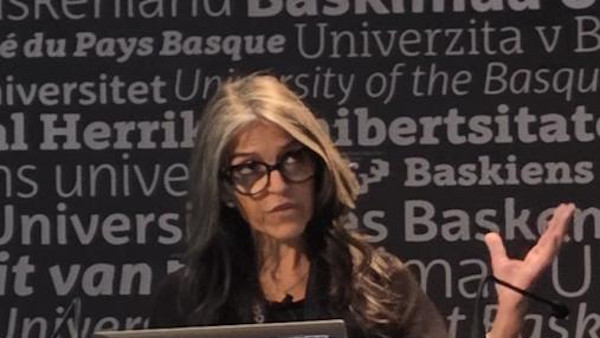
On Thursday 13 November, Elena Seoane delivered a plenary at AEDEAN 48, held in Vitoria-Gasteiz. She argued that the loss of Spanish and Llanito is not ‘natural’ or ‘inevitable’, and that the marginalisation and invisibilisation of all literature focused on Gibraltar (i.e. the literary works by M. G. Sanchez, Humbert Hernandez, and Giordano Durante, among others) is not ‘accidental’. Both phenomena, she claimed, are products of colonialingualism: the erasure of local epistemicities in favour of imperial values stemming from active internalised British colonialism and globalisation as a form of neocolonisation.
Marina Pérez, Victoria Rodríguez, Verónica Silva, Cristina Suárez and Pablo Vilas presented their work on Gibraltar English and South-East Asian Englishes at AEDEAN 48, held at Vitoria-Gasteiz on 12-14 November.
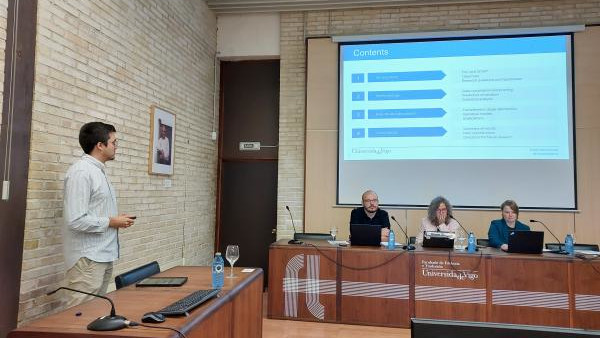
Pablo Vilas Santamaría defended his PhD entitled "Probabilistic Variation in Postcolonial Englishes: The Clausal Complementation Profile of ADMIT”, supervised by ViEW members Elena Seoane and Cristina Suárez-Gómez.
We thank the board members for coming to Vigo and for the valuable feedback: Professors Sofía Rüdiger (University of Berlin), Lucía Loureiro-Porto (University of the Balearic Islands) and Sven Leuckert (University of Dresden).
Congratulations, Dr Vilas!

PhD candidate Pablo Vilas Santamaría organised a two-hour seminar entitled Rethinking English(es): Varieties, Attitudes, and Boundaries. This took place on 10 September and included the following speakers and talks:
Emma Kainz (Tulane University): "English in the Guyanese Classroom: Teacher Perceptions and Language Boundaries"
Cristina Suárez Gómez (Universitat de les Illes Balears): "Language attitudes in World Englishes"
Anastasia Beloborodova (Universidade de Vigo): "Complementation patterns of DENY in Pakistani, Indian, American and British English"
A round table on World Englishes moderated by Pablo closed the seminar, with Emma Kainz, Cristina Suárez Gómez, Anastasia Beloborodova & Elena Seoane discussing methodologies and answering general questions from the audience.
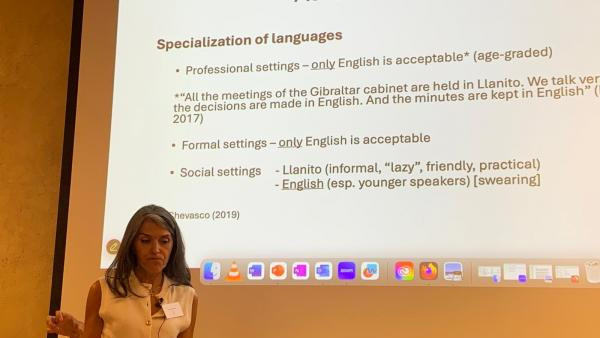
The Third Gibraltar International Conference took place at the University of Basel on 4-6 September 2025. PhD cadidate Verónica silva-Folgar delivered a paper on code-switching entitled "The use of grammatical markers in spoken Gibraltar English: A corpus study". Elena Seoane presented the Gibraltar Digital Project and participated in a round table discussing "Llanito and the linguistic situation in Gibraltar: Sociolinguistis inputs".
In this conference it was announced that GIC4 will take place at the University of Cádiz in May 2026.
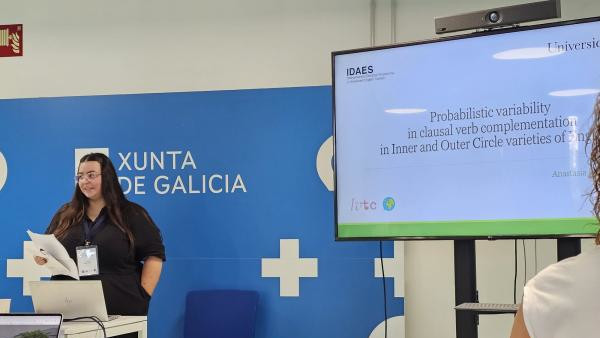
PhD candidates Anastasia Beloborodova and Marina Pérez-Martín participated at the IsLE 8 Conference, held in Santiago de Compostela, 1-4 September. Anastasia's paper was entitled "Probabilistic variability in clausal verb complementation in Inner and Outer Circle varieties of English", whereas Marina's paper dealt with the expression of the perfect in Irish English, comparing the Republic of Ireland with Northern Ireland.

Our research project "Morphosyntactic variation in World Englishes: Exploring Gibraltar English in Context" (Multi-ViEW) has received four-year funding plus a four-year PhD research position from the National Programme for the Generation of Knowledge 2024 (Spanish Ministry of Science, Innovation and Universities, grant PID2024-157009NB-100). This research project will be carried out in collaboration with Anne Lauren Beatty Martínez (California University at San Diego),Sarah Buschfeld (TU Dortmund), Eugenio Goria (University of Turin), Turo Hiltunen (Helsinki University),Manfred Krug, Fabian Vetter (Bamberg University), Mark G. Sánchez (Gibraltarian writer) and Laura Wright (University of Cambridge).
Gibraltar Digital Project: A New Online Resource for Gibraltarian Literature and Language.
The Gibraltar Digital Project, a new website developed by the ViEW research group, has officially launched. The new digital platform consolidates resources dedicated to the study of Gibraltarian Literature and Language, offering an evolving repository of materials intended for researchers, educators, and engaged readers alike.
Academics have frequently noted the limited presence of information about Gibraltarian writing on official Gibraltarian government and institutional websites, something which is very surprising given the growing and widespread international interest in the subject. In fact, just in the last few weeks we have seen two major scholarly journals issuing calls for papers on Gibraltarian writing and two books (one published by the prestigious academic publishing house Routledge) appearing with full-length essays on Gibraltarian writing. Our intention with this project is to create a focused platform where literary and linguistic work from Gibraltar can be documented, explored, celebrated, and made more accessible.
The site currently features bibliographies highlighting Gibraltarian writing and scholarship, as well as select archival documents and contextual materials that serve both academic and public interest. A dedicated Special Features section is planned, which will include interviews with local writers and other thematically curated contributions. A subscription option is also available, allowing visitors to receive updates as new content is added. The site can be viewed at www.gibraltardigitalproject.com
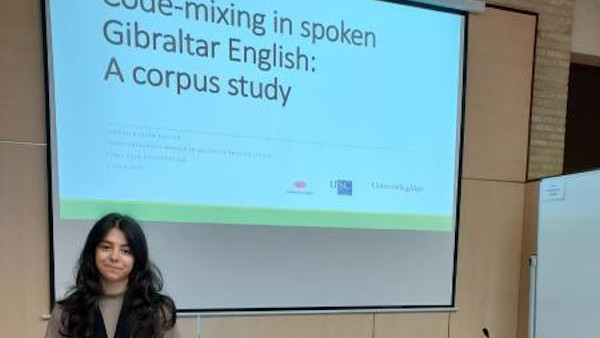
On 2 July, Verónica Silva Folgar defended her Master's thesis, titled "Code-mixing in spoken Gibraltar English: A corpus study" (supervisor: Elena Seoane).
She obtained the highest mark and intends to continue this line of research for her PhD.
Congratulations, Verónica!