

News

News
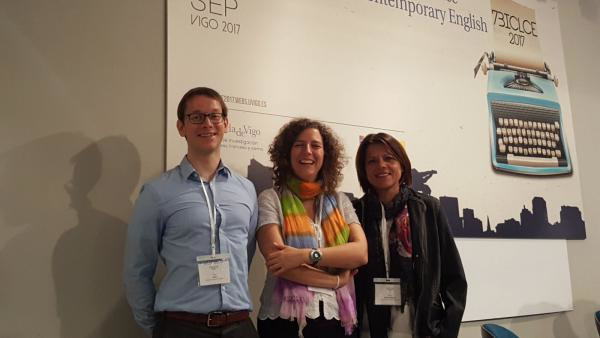
On 28 September, our team members Cristina Suárez-Gómez and Lucía Loureiro-Porto successfully organised, together with Robert Fuchs (Hong Kong Baptist University), the workshop entitled "Morphosyntactic Variation in World Englishes: Apparent-time and diachronic studies" within the International Conference 7BICLCE (Vigo, 28-30 September). The workshop gathered eight papers, by: Mikko Laitinen (Eastern Finland), Beke Hansen (Kiel) & Benedikt Heller (Leuven), Robert Fuchs (Hong Kong), Debra Ziegeler & Christophe Lenoble (Sorbonne Nouvelle), Sandra Deshors (Michigan State), Paloma Núñez-Pertejo & Ignacio Palacios (Santiago de Compostela), Jennifer Thorburn (Lausanne) & Marije van Hattum (Manchester), Guyanne Wilson (Bochum). Please click on conference programme to see the list of titles.
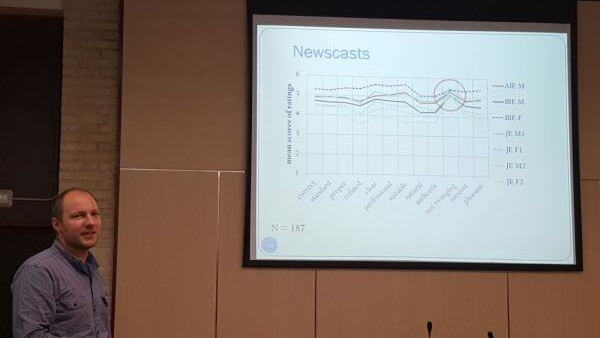
On 2 October Dr. Michael Westphal, from the University of Münster, gave a seminar entitled New Englishes - New Methods, divided into two parts. Part 1 dealt with Tag questions across Englishes with a focus on text type variation, and part 2 concentrated on language attitude research with special reference to mixed methods. Thank you to all the professors, researcher and students who attended the seminar and thank you Michael for an excellent seminar! Here follows an extended abstract of the seminar.
Part1: Tag questions across Englishes: Focus on text type variation
Part 2: Language attitude research: Focus on mixed-methods
The two-part seminar highlights the methodological challenges and the potential of new or mixed-methods approaches in research on New Englishes. The first part, Tag questions across Englishes: Focus on text type variation, discusses these challenges and the potential with regard to corpus linguistics, focusing on text type. The International Corpus of English (ICE), with its growing number of matching national components and diverse text types, provides a rich tool for cross-variety analyses of New Englishes and for the description of their internal variability with regard to text type. However, most ICE-based cross-variety research does not include text type variation as most studies either pool text types together (e.g. Bernaisch 2015) or focus exclusively on informal conversations (e.g. Mair 2009; Columbus 2009). Furthermore, research on text type variation is dominated by Biber’s (1993) Multidimensional Analysis, which uses standardized grammatical and functional classes of linguistic features easily identifiable with tagging systems, and by an understanding of text type differences solely with regard to formality. This focus does not take the communicative situations of different text types earnestly and excludes many linguistic phenomena typical for New Englishes, such as the integration of L1 or creole features into Standard English usage, which are also very often not identifiable via standard taggers. These biases then potentially lead to conclusions falling short of the complexity of text type variation in New Englishes.
In my post doc-project, I want to show the importance of pragmatic variation along different text types and thus highlight alternatives to established approaches: I analyze the variation in the form and function of tag questions across different varieties of English and text types using different ICE corpora. First results from Trinidad and the Philippines show that local (Trinidadian Creole and Tagalog) tags are used more frequently in informal conversations than in more formal classroom lessons and legal cross-examinations. However, the overall frequency of tags and their function depends strongly on the communicative setting of the text type. I want to show that it is beneficial to include pragmatic variables into the canon of research on New Englishes and to take the communicative roles and needs of speakers in specific text types more earnestly.
The second part, Language attitude research: Focus on mixed-methods, gives a brief introduction to language attitude research highlighting problems of established methods with regard to research on New Englishes and then presents the results of a mixed-methods study on the perception of linguistic variation in Jamaican radio newscasts. Language attitude research usually relies on written questionnaires with closed questions, and an acontextual design to ensure generalizability. Furthermore, abstract variety labels are commonly used instead of authentic vocal renditions of linguistic variation. However, written questionnaires exclude many demographics, closed questions leave very little room for the informants to express their beliefs, and abstract variety labels are problematic in New English contexts as different language varieties are not fully enregistered. In addition, context-sensitive research designs are needed for research on New English speech communities as here the use and the attitudes toward different languages and dialects are tied to specific contexts.
One section of my PhD thesis Language Variation on Jamaican Radio (Westphal 2017) addresses the perception of linguistic variation in Standard English in Jamaican radio newscasts. For this language attitude study, I use a mix of different methods, including an accent rating study of seven authentic recordings of Jamaican newscasts, direct questions using abstract variety labels, and qualitative interviews. The accent rating study illustrates linguistic deference among the Jamaican informants toward British and American influenced English, while the results of direct questioning show loyalty toward Jamaican English. The qualitative interviews help to explain these differences: the informants did not rate the Jamaican newscasters with foreign influenced accents as speakers of British or American varieties but as very specific and especially reliable newscasters. This mix of methods shows the complexity of ideological dispositions speakers in multilingual/-dialectal speech communities live with on a daily basis. Quantitative methods need to be complemented with qualitative designs, which have the potential to show aspects not anticipated in the research design and leave more room for the users’ perspective.
References
Bernaisch, T. 2015. The lexis and lexicogrammar of Sri Lankan English. Amsterdam: John Benjamins.
Biber, D.. 1993. The multidimensional approach to linguistic analyses of genre variation: An overview of methodology and findings. Computers and Humanities 26 (5/6), 331–345.
Columbus, G. 2010. A comparative analysis of invariant tags in three varieties of English. English World-Wide 31(3), 288–310.
Mair, C. 2009. Corpus linguistics meets sociolinguistics. In T. Hoffmann & L. Siebers (Eds.), World Englishes – Problems, Properties and Prospects (pp. 39–60). Amsterdam: John Benjamins.
Westphal, M. 2017. Language variation on Jamaican radio. Amsterdam: John Benjamins.
Elena Seoane has been appointed to serve at the Editorial Board of the new John Benjamins' journal Register Studies (ISSN 2542-9477), edited by Jesse Egbert (Northern Arizona University) and Bethany Gray (Iowa State University), with Douglas Biber (Northern Arizona University) as Consulting Editor. Register Studies is a refereed journal devoted to the publication of empirical, methodological, and theoretical research on register and its relationship to all aspects of language use, variation, change, and learning.s highly interdisciplinary, welcoming scholarship on register from areas such as corpus linguistics, discourse analysis, sociolinguistics, applied linguistics, Systemic Functional Linguistics, language teaching, and computational linguistics. Research on English-language registers, analyses of registers in languages other than English, and cross-linguistic comparisons of registers are welcome. Register Studies regularly publishes reviews of books, corpora, and research tools focused on register research. All contributions undergo double-blind peer review.
On 14 June Raquel P. Romasanta successfully defended her MA thesis entitled "Synchronic Variation in Clausal Complementation: The case of regret in British and American English". This is her initial step towards a PhD on morphosyntactic variation in World Englishes, which will be supervised by Elena Seoane.
Congratulations, Raquel!
At the General Assembly of ICAME, held during the 38th ICAME Conference which took place at Charles University in Prague (23 to 28 May 2017), Elena Seoane was nominated and elected as a new member of the ICAME Executive Board, where she will serve for a period of four years (opting to renewal for another four years). ICAME is the International Computer Archive of Modern and Medieval English, an international organization of linguists and information scientists working with English machine-readable texts. The aim of the organization is to collect and distribute information on English language material available for computer processing and on linguistic research completed or in progress on the material, as well as to to compile an archive of English text corpora in machine-readable form, and to make material available to research institutions. ICAME publishes the ICAME Journal, which appears once a year, with articles and information about English computer corpora.
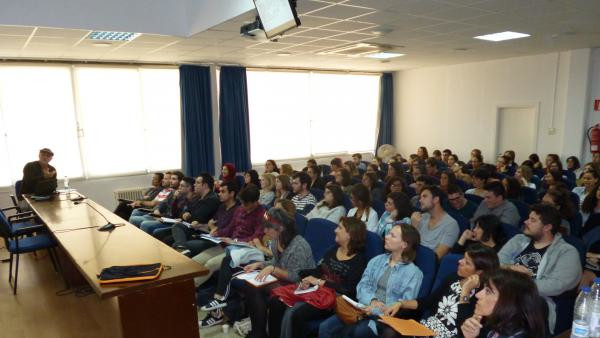
As previously announced, on 26 April the Symposium Language and Identity in Gibraltar was held at the University of the Balearic Islands. The turn out was spectacular, with over 80 students and members of staff, and the interest generated by Gibraltarian writer Mark G. Sanchez was highly remarkable. The organisers, Cristina Suárez-Gómez and Lucía Loureiro Porto, who also participated in the symposium together with Elena Seoane, want to express their gratitude to M. G. Sanchez for his inspiring talk and his participation, as well as to all the attendants to this event.
On 26 Abril the Symposium Language and Identity in Gibraltar will take place, organised by Cristina Suárez-Gómez and Lucía Loureiro-Porto. They will open the symposium with a talk on the "Sociolinguistic situation in Gibraltar: English, Spanish and Yanito." Invited speakers are Elena Seoane (University of Vigo), who will focus on the compilation of the Gibraltarian component of the ICE (International Corpus of English) project with a talk entitled "Resources for the study of Gibraltar English: Compiling a representative corpus" and Gibraltarian writer Mark G. Sanchez, who will give a lecture on "The border and its impact on the Gibraltarian mind". Full abstracts of the talks and other details can be found at http://sac.uib.cat/act_sac/formacio/16-17/Gibraltar.

On 16 November 2016 we hosted the Seminar The Sociolinguistics of Gibraltar in the 21st Century. The program comprised three talks, the first by Cristina Suárez-Gómez (University of the Balearic Islands) with the title “Gibraltarian English and its status within ‘World Englishes’”, which dealt with the recent history of Gibraltar and the linguistic status of Gibraltarian English according to model of analyses of World Englishes, essentially Schneider’s (2007) Dynamic Model and the analyses of data by D. Levey and D. Weston. The second talk, entitled “The compilation of the International Corpus of Gibraltar English: problems and prospects” was delivered by Raquel Pereira Romasanta and Elena Seoane (University of Vigo) and explained the challenges encountered and resources involved in the ongoing compilation of the Gibraltar component of ICE, in which all speakers of the seminar are involved. Finally, Dr. Jennifer Ballantine, Director of the Gibraltar Garrison Library and the Research Institute for Gibraltar and Mediterranean Studies (University of Gibraltar), talked about “Language in Gibraltar”. Here follows the abstract of her talk. We would like to express our gratitude to all the staff members, undergraduate, MA and postgraduate students who attended the seminar.
It can be difficult to pin down exactly when the English language became the main language for Gibraltarians, that is, as opposed to Spanish, and even then, the question of Spanish as a mainstream language in Gibraltar deserves further consideration. It is clear, however, that English has become the main language for a younger generation of Gibraltarians. A number of reasons have been discussed as the main causes for this decline in the use of Spanish, especially amongst the Generation Y, and this is a subject that has given rise to much debate. It is certainly a question that I have given much thought to, especially in light of Gibraltar’s geo-historical context where we see a community rising from the ashes, so to speak, from a 1704 conquest that turns everything around for Gibraltar. From that point on we see a territory informed by a multiculturalism and cosmopolitanism that has continued to influence the cultural identity of the place. Still, this diversity also brought many different languages to Gibraltar, with records telling us of a polyglot society, of people ‘speaking in tongues’ , and of Gibraltarians who recall hearing Maltese and Genoese being spoken in their homes well into the 20th century. So my question is, how have we arrived at this point in history when all these languages have all but disappeared and we are now concerned that Spanish is also in decline. My paper will therefore be concerned as much with the 21st century as with the historical past, as a means to understand a trajectory that informs cultural and linguistic norms in Gibraltar.
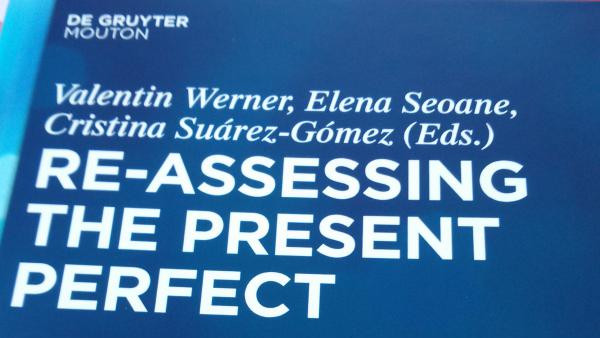
Our new book is now available: Re-assessing the Present Perfect. Corpus studies and beyond, issue 91 of the De Gruyter's series TiEL (Topics in English Linguistics), edited by Valentin Werner (University of Bamberg), Elena Seoane & Cristina Súarez-Gómez, both ViEW members. The contributors of the volume are Berit Johannsen, Jill Bowie & Sean Wallis, Markku Filppula, Bertus van Rooy, Robert Fuchs, Julia Davydova, Elena Seoane, Sophie Richard & Celeste Rodríguez Louro, Valentin Werner, Björn Rohstein, Robert Fuchs, Sandra Götz & Valentin Werner, to whom we are deeply grateful.
It is a well-known fact that the area of the present perfect has always been a hotly contested ground, but recent corpus analyses have shown that grammatical variation in this realm in English is far more pervasive than previously assumed. This volume is the first ever book-length treatment dedicated to corpus-based work on the present perfect. It offers fresh theoretical insights resting on a solid empirical footing and investigates central aspects of language contact and change, grammaticalization, typology, and dialect formation. It sheds light on this morphosyntactic area from different angles, as it comprises both diachronic and synchronic viewpoints. Contributions explore variation in the expression of perfect meaning and the multifunctionality of perfect forms in a number of native and non-native varieties, thus going beyond the traditional British/American English paradigm, while a second focus lies on cross-variety comparisons. Bringing together the knowledge of leading experts in the field, this book represents the state of the art in data-driven research on the present perfect and will be of interest for those working in the fields of language variation and change, corpus linguistics, sociolinguistics, and typology.